Masturbacja mnie pochłania
Pytanie, z którym możesz się utożsamić
Mam 45 lat. Rozstałem się z partnerką, nie mam dzieci, dobrze zarabiam i mieszkam sam. Kiedy wracam z pracy, wchodzę na strony z erotycznymi transmisjami na żywo. Patrzę na atrakcyjne, młode dorosłe kobiety i masturbuję się godzinami, czasem wielokrotnie, aż zaczynam odczuwać ból. Nie potrafię przestać. Mam nadwagę, nie czuję się atrakcyjny dla młodszych kobiet, a kobiety w moim wieku mnie nie pociągają. Coraz więcej wieczorów spędzam przed ekranem. Co się ze mną dzieje i jak mogę odzyskać kontrolę?
Pytanie opracowane na potrzeby poradnika.
Jestem psychologiem i popularyzatorem wiedzy psychologicznej. Na Psycholog.CLICK podejmuję również tematy dotyczące intymności, seksualności i zachowań, o których trudno mówić bez skrępowania. Jeśli chcesz zaproponować temat kolejnego artykułu, napisz na psycholog@psycholog.click lub skontaktuj się ze mną przez WhatsApp. Jeśli natomiast czujesz, że określone zachowanie zaczyna przejmować kontrolę nad twoim życiem, możesz umówić konsultację psychologiczną online, podczas której wspólnie uporządkujemy sytuację i rozważymy możliwości dalszej pomocy.
Można mieć satysfakcjonującą pracę, pieniądze, własne mieszkanie i jednocześnie coraz słabiej panować nad tym, co dzieje się po zamknięciu drzwi. Masturbacja sama w sobie jest zwyczajnym zachowaniem seksualnym. Kiedy jednak trwa mimo bólu, pochłania kolejne godziny i wymyka się spod kontroli, potrzebne jest poważniejsze potraktowanie problemu. Pierwszym krokiem nie musi być deklaracja całkowitej abstynencji. Powinno nim być zatrzymanie zachowania powodującego ból, a następnie rozpoznanie, co naprawdę uruchamia ten powtarzalny wieczorny rytuał.
1. Kiedy przyjemność zaczyna przejmować kontrolę?
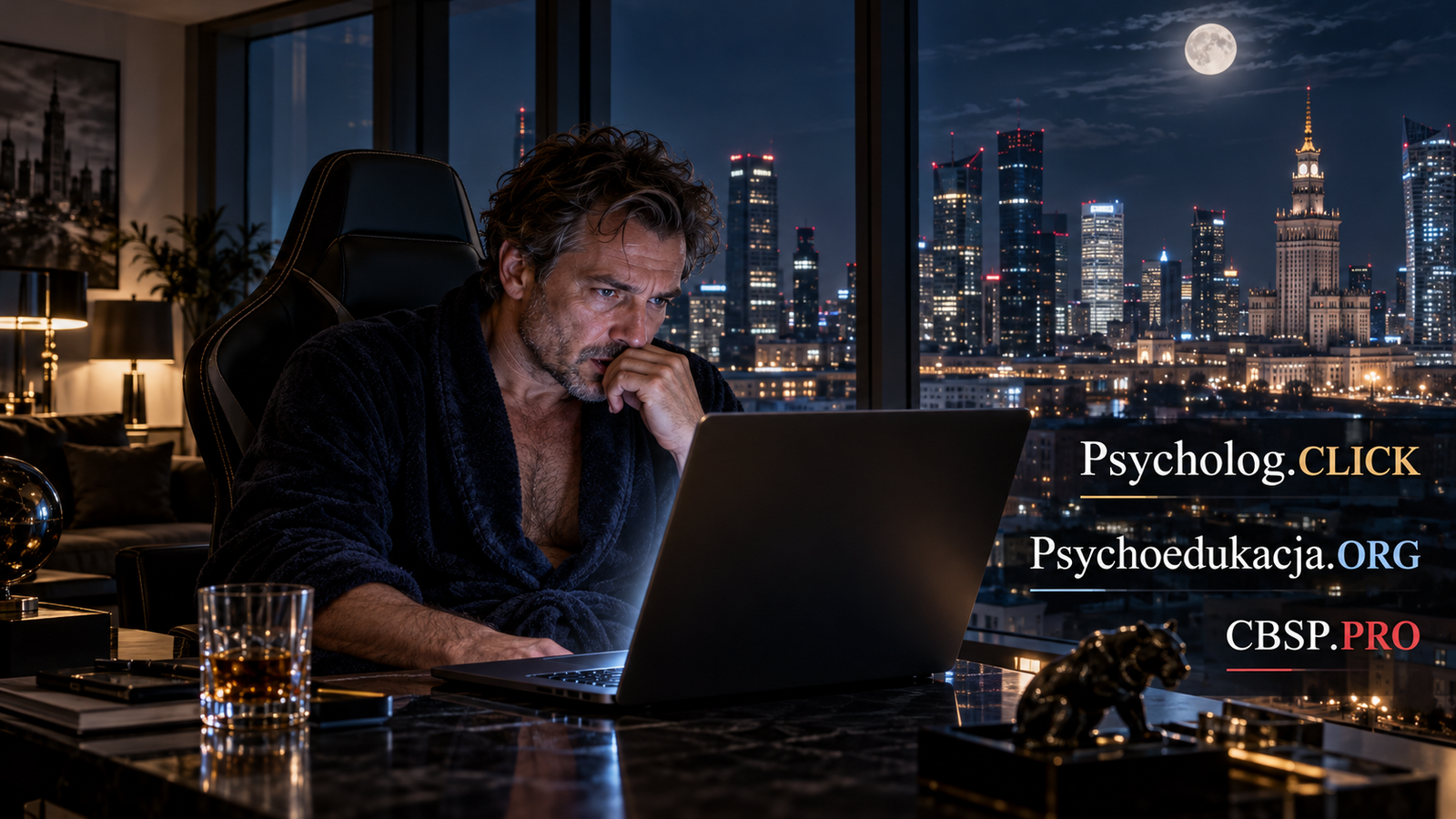
Wyobraź sobie mężczyznę, który kończy pracę o siedemnastej. Jest kompetentny, odpowiedzialny, dobrze radzi sobie zawodowo. W drodze do domu robi zakupy, odbiera przesyłkę, odpowiada na kilka wiadomości. Wszystko przebiega zwyczajnie.
Później otwiera drzwi mieszkania.
Nikt na niego nie czeka. Nie musi opowiadać, jak minął dzień. Nie ma wspólnego obiadu ani ustalonych planów na wieczór.
Włącza komputer.
Jedna strona, jedna transmisja, jedna atrakcyjna kobieta. Później następna. Jeszcze kilka minut, kolejny występ, kolejna próba osiągnięcia przyjemności.
O drugiej nad ranem odkrywa, że znów stracił cały wieczór.
To przykład hipotetyczny, ale pokazuje sytuację, w której zachowanie seksualne zaczyna pełnić funkcję wykraczającą poza zaspokojenie pobudzenia.
Sama masturbacja, nawet częsta, nie świadczy o zaburzeniu. Nie istnieje jedna prawidłowa liczba orgazmów w tygodniu. Nie można również uznać człowieka za chorego tylko dlatego, że korzysta z legalnych materiałów erotycznych prezentujących dorosłe osoby.
Znaczenie mają konsekwencje.
Czy potrafisz odłożyć zachowanie, kiedy postanowisz zrobić coś innego? Czy przerywasz je, kiedy pojawia się ból? Czy nadal masz czas na odpoczynek, znajomych, sen i zainteresowania? Czy seksualność pozostaje jednym z obszarów życia, czy zaczyna organizować wszystkie pozostałe?
W klasyfikacji ICD-11 opisano zaburzenie kompulsywnych zachowań seksualnych, określane skrótem CSBD. Jego istotą jest utrzymujący się wzorzec trudności w kontrolowaniu intensywnych impulsów i powtarzających się zachowań seksualnych, prowadzący do istotnego cierpienia lub pogorszenia funkcjonowania.
Wzorzec musi utrzymywać się przez dłuższy czas, przykładowo co najmniej sześć miesięcy. Może obejmować wielokrotne nieskuteczne próby ograniczania zachowania, kontynuowanie go pomimo negatywnych konsekwencji oraz podporządkowanie mu ważnych dziedzin życia.
Nie wystarczy jednak sama częstotliwość ani sam wstyd wynikający z przekonań moralnych.
Zachowania tego rodzaju zaklasyfikowano w ICD-11 do zaburzeń kontroli impulsów. Nie jest to automatycznie to samo, co rozpoznanie uzależnienia od substancji psychoaktywnych.
Czy człowiek z przedstawionego pytania spełnia kryteria CSBD?
Nie wiemy.
Znamy jego wiek, sytuację życiową i pewne zachowania. Nie znamy czasu trwania problemu, liczby rzeczywistych prób ograniczenia ani szerszego funkcjonowania psychicznego. Nie przeprowadzono oceny klinicznej.
Wiemy jednak coś bardzo konkretnego: opisuje ból oraz poczucie niemożności przerwania zachowania.
To wystarczający powód, żeby potraktować sprawę poważnie, bez przyklejania diagnozy.
Chciałbym również odróżnić masturbację od wielogodzinnego korzystania z erotycznych transmisji. To dwa powiązane, lecz różne elementy doświadczenia.
Można masturbować się bez pornografii. Można oglądać materiały erotyczne bez masturbacji. Można też godzinami przeglądać transmisje, szukając coraz to nowych bodźców lub kontaktu z konkretną osobą.
Dopiero rozdzielenie tych zachowań pozwala ustalić, z którym z nich rzeczywiście występuje trudność.
2. Sprawdź, jak bardzo wpływa to na twoje życie
Poniższa tabela nie jest testem ani narzędziem diagnostycznym. Pomaga ocenić konsekwencje zachowania i zdecydować, jaka forma wsparcia może być odpowiednia.
| Poziom | Co można zaobserwować | Pierwszy krok | Dalsza pomoc |
|---|---|---|---|
| Sporadyczne trudności | Masturbacja lub oglądanie transmisji trwa czasem dłużej, niż planowałeś, ale potrafisz przerwać i nie występują istotne szkody. | Obserwuj, w jakich sytuacjach korzystasz z materiałów erotycznych. | Jeśli nie występuje cierpienie ani pogorszenie funkcjonowania, może wystarczyć świadoma zmiana nawyków. |
| Trudności powracające i ograniczające życie | Wieczory regularnie mijają przed kamerami, zaniedbujesz sen albo kontakty społeczne, a próby ograniczenia nie przynoszą efektu. | Przeanalizuj wyzwalacze, czas korzystania i konsekwencje. | Rozważ konsultację psychologiczną lub seksuologiczną. |
| Znaczne obciążenie funkcjonowania | Zachowanie trwa mimo bólu, zaburza sen, wpływa na zdrowie, wydatki lub pracę; masz wyraźne poczucie utraty kontroli. | Przerwij czynność powodującą ból i zadbaj o ocenę zdrowia. | Wskazana jest konsultacja lekarska oraz specjalistyczna ocena psychologiczna lub seksuologiczna. |
Jeśli pojawia się silny lub narastający ból, krwawienie, znaczny obrzęk, uraz albo trudności z oddawaniem moczu, konieczna jest pilna ocena medyczna.
Nie chciałbym, żebyś potraktował tę tabelę jako konkurs na to, czy jesteś już wystarczająco chory, żeby poprosić o pomoc.
Możesz zgłosić się do specjalisty wcześniej.
Istotne jest również to, że dobra sytuacja materialna i poprawne wykonywanie obowiązków zawodowych nie wykluczają znaczącego cierpienia w życiu prywatnym.
Człowiek może przez osiem godzin zachowywać pełną kontrolę, a przez kolejne sześć doświadczać czegoś zupełnie innego.
Nie oznacza to jednak istnienia dwóch osobowości ani żadnego szczególnego typu psychicznego.
Pokazuje raczej, że zachowanie może zależeć od kontekstu, dostępności bodźców, utrwalonych przyzwyczajeń i sposobu radzenia sobie z emocjami.
3. Dlaczego właśnie wieczorem? Trzy możliwe mechanizmy
Nie ma jednego psychologicznego mechanizmu, który wyjaśniałby wszystkie przypadki problematycznej masturbacji lub korzystania z pornografii.
W przedstawionej historii dostrzegam jednak trzy obszary warte dokładniejszego zbadania.
Samotność i regulacja emocji
Pierwszy dotyczy sytuacji po rozstaniu.
Przez wiele lat człowiek może przyzwyczaić się do obecności drugiej osoby. Do jej głosu, sposobu poruszania się, zapachu, spontanicznych kontaktów fizycznych i zwyczajnego poczucia, że jest z kim dzielić codzienność.
Po zakończeniu związku znika nie tylko seks.
Znika także wspólne zasypianie, dotyk niezwiązany z erotyką, zainteresowanie tym, co wydarzyło się w pracy, a czasami nawet poczucie, że ktoś na nas czeka.
Nie zakładam, że tak wygląda sytuacja każdego człowieka po rozstaniu. Niektórzy odczuwają ulgę, inni chętnie korzystają z samotności, a jeszcze inni cierpią znacznie bardziej, niż pokazują otoczeniu.
Możliwe jednak, że mężczyzna z opisanego pytania próbuje wypełnić określoną lukę.
Transmisja erotyczna daje mu pobudzenie i zajęcie uwagi. Jeśli może pisać do kobiety, otrzymywać odpowiedzi albo zostać zauważonym, pojawia się również element kontaktu.
Przez pewien czas samotność może stać się mniej odczuwalna.
Problem powstaje wtedy, kiedy jest to podstawowy sposób radzenia sobie z nią.
Po wyłączeniu ekranu sytuacja życiowa pozostaje przecież niezmieniona.
Czasami to właśnie wtedy pojawia się największy dyskomfort.
Utrwalony rytuał i oczekiwanie nagrody
Drugi mechanizm dotyczy uczenia się zachowania.
Wyobraź sobie powtarzającą się sekwencję: powrót z pracy, samotne mieszkanie, komputer, strona internetowa, pobudzenie, chwilowa ulga.
Jeżeli taki układ powtarza się przez wiele tygodni, określone okoliczności mogą zacząć automatycznie kojarzyć się z czynnością.
Samo wejście do mieszkania może uruchamiać oczekiwanie wieczornego rytuału.
W psychologii uczenia istotne są zarówno nagrody, jak i redukcja nieprzyjemnych stanów.
Przyjemność seksualna może sprzyjać powtarzaniu zachowania. Podobną funkcję może pełnić chwilowe zmniejszenie napięcia, znudzenia lub poczucia osamotnienia.
Transmisje na żywo dodatkowo wprowadzają nieprzewidywalność.
Nie wiadomo, kto pojawi się przed kamerą, czy wybrana osoba odpowie, jak będzie wyglądał następny występ.
Człowiek może więc kontynuować przeglądanie nawet po osiągnięciu orgazmu, ponieważ nadal oczekuje kolejnego interesującego zdarzenia.
Nie trzeba do tego odwoływać się do sensacyjnej opowieści o „zniszczonym przez dopaminę mózgu”.
Mechanizmy uwagi, oczekiwania nagrody, emocji i uczenia się są znacznie bardziej złożone.
Ważne jest przede wszystkim rozpoznanie chwili, w której zachowanie przestaje być świadomie wybraną aktywnością i staje się niemal automatyczną odpowiedzią na konkretną sytuację.
Atrakcyjność, samoocena i potrzeba bycia zauważonym
Trzeci mechanizm może być najbardziej bolesny psychologicznie.
Mężczyzna pisze, że ma nadwagę i nie interesują się nim młodsze kobiety. Jednocześnie deklaruje, że kobiety w jego wieku budzą w nim niechęć.
Zauważ, jak wiele mieści się w tych dwóch zdaniach.
Jest ocena własnego ciała.
Jest przekonanie o własnej atrakcyjności.
Jest wyobrażenie, kogo powinien zdobywać.
I jest bardzo surowa ocena określonej grupy kobiet.
Nie zamierzam potępiać człowieka za to, że pociągają go młodsze dorosłe osoby. Preferencje seksualne mogą być zróżnicowane.
Nie oznacza to jednak, że każda ocena własnej atrakcyjności jest trafna, a każde przekonanie o innych ludziach zasługuje na utrwalenie.
Jeżeli ktoś twierdzi, że żadna kobieta w jego wieku nie może go pociągać, warto zapytać, czy mówi o swoich rzeczywistych doświadczeniach, czy raczej o obrazie atrakcyjności zbudowanym na podstawie intensywnego korzystania z wyselekcjonowanych materiałów erotycznych.
A może pogarda wobec kobiet w podobnym wieku chroni go przed ryzykiem spotkania z kimś, kto również może go ocenić lub odrzucić?
To hipoteza, nie rozpoznanie.
Istotna jest także samoocena.
Mężczyzna może widzieć w sobie przede wszystkim nadwagę, a w kobietach przed kamerą wyłącznie idealizowaną młodość i urodę.
Tak powstaje nierówne porównanie.
Swoje realne, codzienne ciało zestawia z profesjonalnie przygotowanym obrazem osoby, której wygląd i sposób prezentacji stanowią część pracy.
Nie porównuje dwóch ludzi w tych samych okolicznościach.
Porównuje własną rzeczywistość z cudzą starannie przygotowaną prezentacją.
To może wzmacniać poczucie niedopasowania, choć nie mamy podstaw, by stwierdzić, że właśnie ten mechanizm odpowiada za cały problem.
4. Co rzeczywiście pokazują badania naukowe?
Badania nad problematycznym korzystaniem z pornografii i kompulsywnymi zachowaniami seksualnymi rozwijają się od wielu lat. Nadal jednak istnieją spory dotyczące definicji, metod pomiaru i najlepszych sposobów pomocy.
Zacznę od ustaleń, które uważam za szczególnie przydatne.
Utrata kontroli jest ważniejsza niż moralna ocena seksu
Kraus i współpracownicy (2018), omawiając kompulsywne zachowania seksualne w kontekście ICD-11, wskazali znaczenie utrwalonego wzorca ograniczonej kontroli, konsekwencji życiowych oraz cierpienia.
Podkreślili również, że cierpienie wynikające wyłącznie z moralnego potępiania własnych zachowań seksualnych nie wystarcza do rozpoznania zaburzenia.
To bardzo ważne rozróżnienie.
Człowiek może masturbować się rzadko, a mimo to odczuwać ogromne poczucie winy, ponieważ uważa masturbację za niedopuszczalną.
Ktoś inny może nie mieć żadnego konfliktu moralnego, a jednocześnie regularnie kontynuować zachowanie mimo bólu, utraty snu i licznych nieskutecznych prób ograniczenia.
Obie osoby mogą cierpieć, ale źródła trudności i potrzebna pomoc mogą się różnić.
Z problemem wiążą się różne drogi psychologiczne
Grubbs i współpracownicy (2019) przedstawili model uwzględniający znaczenie niezgodności między przekonaniami moralnymi a zachowaniem seksualnym.
Lewczuk i współpracownicy (2020) analizowali trzy możliwe drogi związane z problematycznym korzystaniem z pornografii: trudności w samoregulacji, utrwalone nawyki korzystania oraz konflikt moralny.
W badaniu obejmującym dorosłych uczestników z Polski wykazano, że te obszary były w różnym stopniu związane z oceną własnego zachowania jako problematycznego.
Badanie miało jednak charakter przekrojowy.
Nie dowodzi zatem, że jeden konkretny mechanizm bezpośrednio powoduje problem u określonego człowieka.
Dla praktyki ważne jest coś innego: dwie osoby spędzające tyle samo czasu na oglądaniu pornografii mogą robić to z różnych powodów i potrzebować odmiennego wsparcia.
Psychoterapia może pomagać, ale dowody mają ograniczenia
Antons i współpracownicy (2022) przeanalizowali 24 badania dotyczące interwencji wobec kompulsywnych zachowań seksualnych i problematycznego korzystania z pornografii. Cztery z nich miały charakter badań randomizowanych.
Wyniki dawały podstawy do ostrożnego optymizmu, szczególnie wobec interwencji wykorzystujących elementy terapii poznawczo-behawioralnej.
Autorzy zaznaczyli jednak, że jakość i różnorodność badań ograniczają możliwość formułowania mocnych wniosków.
Nowsza metaanaliza López-Pinara, Esparzy-Reiga i Bőthe (2025) objęła 20 badań z łącznym udziałem 2021 osób.
Analizy wykazały poprawę u osób korzystających z psychoterapii, zwłaszcza w zakresie problematycznego używania pornografii i zachowań kompulsywnych. Badania dotyczyły przede wszystkim terapii poznawczo-behawioralnej oraz terapii akceptacji i zaangażowania, określanej skrótem ACT.
Jednocześnie autorzy stwierdzili istotne ograniczenia metodologiczne, w tym wysokie ryzyko błędu systematycznego.
Nie można więc obiecywać, że określona metoda pomoże każdemu ani że kilka spotkań definitywnie rozwiąże trudność.
Nadal nie ma jednego standardowego programu dla wszystkich
Zwielewski i współpracownicy (2026) dokonali przeglądu badań nad interwencjami opartymi na podejściu poznawczo-behawioralnym.
Do końcowej analizy włączono 11 badań opisujących różne protokoły pomocy.
Wykorzystywano między innymi pracę z emocjami, przekonaniami, silną potrzebą podjęcia zachowania oraz zapobieganiem nawrotom. Część programów korzystała również z ACT i technik uważności.
Rezultaty były obiecujące, ale badacze podkreślili brak wystarczającej standaryzacji oraz trudności metodologiczne.
Briken i współpracownicy (2024), przedstawiając stanowisko ekspertów medycyny seksualnej, zwrócili dodatkowo uwagę na konieczność unikania nadmiernej patologizacji masturbacji, pornografii i wysokiego pożądania seksualnego.
Wspólny wniosek jest zatem rozsądny: profesjonalna pomoc może być skuteczna, ale powinna zaczynać się od rozpoznania konkretnego problemu, nie od automatycznego przypisania człowiekowi etykiety uzależnionego.
Co szczególnie istotne w naszej historii, przytoczone badania nie pozwalają ustalić, że strony z kamerkami bezpośrednio spowodowały niechęć do kobiet w podobnym wieku.
Taka zależność wymagałaby odrębnego zbadania.
5. Największe złudzenie: kobieta z kamery jest dostępna
Chciałbym zwrócić uwagę na słowa użyte w pytaniu.
„One są takie cudowne, nagie, śliczne”.
Nie ma nic niezwykłego w dostrzeganiu atrakcyjności innych ludzi.
Problem może zaczynać się w momencie, kiedy atrakcyjność wizualna zostaje pomylona z dostępnością emocjonalną, romantyczną lub seksualną.
Kobieta pracująca przed kamerą może uśmiechać się do odbiorcy, zwracać się do niego po pseudonimie, odpowiadać na wiadomości i sprawiać wrażenie zainteresowanej.
W niektórych przypadkach kontakt może być autentycznie sympatyczny. Nie należy zakładać, że każda interakcja jest nieszczera.
Jednocześnie pozostaje on częścią określonej usługi, często związanej z wynagrodzeniem.
Zainteresowanie widza nie oznacza, że kobieta chce prywatnej relacji. Jej uprzejmość nie jest obietnicą spotkania, a atrakcyjny wygląd nie tworzy żadnego zobowiązania wobec odbiorcy.
W świecie transmisji erotycznych można kupić określony rodzaj doświadczenia.
Nie można kupić wzajemnego uczucia.
Wyobraź sobie hipotetycznie mężczyznę, który codziennie odwiedza tę samą transmisję. Kobieta zaczyna rozpoznawać jego pseudonim. On czuje się wyróżniony.
Z czasem czeka już nie tylko na erotyczny występ, ale również na moment, kiedy zostanie przywitany.
Pewnego dnia kobieta nie pojawia się online.
Mężczyzna odczuwa rozczarowanie, zaczyna sprawdzać jej profil, zastanawia się, czy o nim pamięta.
Nie wiemy, czy właśnie taka sytuacja dotyczy autora pytania. Jest to jednak możliwy scenariusz, w którym z aktywności erotycznej rozwija się silne jednostronne przywiązanie.
Relacje paraspołeczne, czyli więzi odczuwane wobec osób znanych przede wszystkim z mediów, mogą powstawać w różnych środowiskach. Sam ich fakt nie oznacza zaburzenia.
Warto jednak odróżnić subiektywne poczucie bliskości od wzajemnej, prywatnej relacji.
Drugi mit dotyczy kobiet spotykanych poza internetem.
Jeżeli mężczyzna ocenia atrakcyjność potencjalnej partnerki wyłącznie przez pryzmat młodości, sylwetki i wyglądu, może odrzucać możliwość poznania osoby, z którą rzeczywiście mógłby nawiązać satysfakcjonującą relację.
Nie oznacza to, że powinien zmuszać się do związku z kimś, kto go nie pociąga.
Chodzi o uczciwe zbadanie własnych kryteriów.
Co oznacza dla niego atrakcyjność? Czy oprócz wieku i wyglądu dostrzega temperament, osobowość, inteligencję, poczucie humoru, sposób komunikacji?
Czy szuka rzeczywistej partnerki, czy raczej potwierdzenia, że nadal potrafi zainteresować sobą kobietę znacznie młodszą?
To dwa różne cele.
A niechęć lub pogarda wobec kobiet w podobnym wieku może dodatkowo utrudniać budowanie wzajemnych, opartych na szacunku relacji.
6. Jak odzyskać kontrolę? Konkretny plan działania
Nie proponuję tutaj karania się za pożądanie ani prowadzenia wojny z własną seksualnością.
Celem powinno być odzyskanie możliwości wyboru, ograniczenie szkód i zrozumienie mechanizmu zachowania.
1. Najpierw zatrzymaj działanie powodujące ból
Jeżeli masturbacja prowadzi do bólu, podrażnienia lub uszkodzenia skóry, nie kontynuuj jej wbrew objawom.
Nie próbuj również sprawdzać, ile jeszcze wytrzymasz.
Daj tkankom czas na regenerację, unikaj czynności nasilających dolegliwości i obserwuj, czy objawy ustępują.
Jeżeli ból się utrzymuje, powraca, nasila się lub pojawiają się inne niepokojące objawy, skonsultuj się z lekarzem, odpowiednio do sytuacji z lekarzem podstawowej opieki zdrowotnej lub urologiem.
Częstotliwość masturbacji nie pozwala samodzielnie rozpoznać przyczyny bólu.
Może on wynikać z podrażnienia, urazu albo problemu zdrowotnego niezwiązanego bezpośrednio z samą masturbacją.
W tym przypadku zdrowie fizyczne ma pierwszeństwo przed eksperymentowaniem z samokontrolą.
2. Rozdziel pobudzenie seksualne od korzystania z kamerek
Przez kilka kolejnych dni prowadź krótką obserwację. Nie musisz szczegółowo opisywać fantazji erotycznych ani tworzyć intymnego dziennika.
Wystarczy zanotować:
- O której godzinie pojawiła się potrzeba wejścia na stronę?
- Co wydarzyło się wcześniej?
- Jaki był twój stan emocjonalny?
- Czy odczuwałeś pobudzenie seksualne jeszcze przed włączeniem transmisji?
- Czy chciałeś osiągnąć orgazm, czy przede wszystkim oglądać kolejne kobiety albo nawiązać kontakt?
- Jak czułeś się po zakończeniu?
Szczególnie interesująca może być odpowiedź na czwarte pytanie.
Jeżeli pobudzenie pojawia się dopiero po wejściu na stronę, być może istotną rolę odgrywa nawyk poszukiwania bodźców.
Jeżeli wcześniej odczuwasz wyraźne napięcie seksualne, sytuacja może wyglądać inaczej.
Jeżeli natomiast przed włączeniem komputera dominują smutek, rozdrażnienie lub samotność, warto rozważyć funkcję regulacji emocji.
To hipotezy pomagające zaplanować dalszą obserwację, nie prosty domowy test pozwalający ustalić przyczynę.
Nie oceniaj postępów wyłącznie liczbą orgazmów. Zwracaj uwagę także na czas, cierpienie, sen i zdolność do podejmowania decyzji.
3. Zmień pierwsze pół godziny po powrocie do domu
W opisywanej historii powtarza się jeden wyraźny moment: zakończenie pracy i powrót do samotnego mieszkania.
Dlatego proponuję zacząć właśnie od niego.
Przed powrotem zaplanuj czynność, którą wykonasz zaraz po wejściu do domu.
Może to być przygotowanie kolacji, spacer, telefon do znajomego, ćwiczenia fizyczne dostosowane do możliwości albo wyjście na zaplanowane spotkanie.
Nie chodzi o to, żeby zmęczyć się do utraty przytomności i nie mieć siły na masturbację.
Chodzi o przerwanie automatycznej sekwencji.
Jeżeli przez ostatnie miesiące pierwszą czynnością po przyjściu do mieszkania było uruchomienie erotycznej strony, samo postanowienie „dzisiaj nie wejdę” może nie wystarczyć.
Potrzebna jest wcześniej przygotowana alternatywa.
Możesz także usunąć zapisane skróty do stron, wyłączyć powiadomienia, wylogować się z kont oraz zastosować narzędzia ograniczające dostęp do określonych witryn.
Takie rozwiązania nie stanowią leczenia. Mogą jednak zmniejszyć łatwość automatycznego rozpoczynania zachowania.
Jeśli omijasz zabezpieczenia po kilku minutach, potraktuj to jako informację o sile utrwalonego schematu, a nie dowód osobistej porażki.
4. Naucz się odraczać impuls, zamiast natychmiast go realizować
Silna potrzeba wykonania określonej czynności nie zawsze wymaga natychmiastowego działania.
Kiedy pojawi się ochota na otwarcie transmisji, spróbuj odroczyć decyzję o dziesięć minut.
Nie musisz w tym czasie udowadniać sobie, że nie wolno ci odczuwać pożądania.
Możesz powiedzieć sobie: „Czuję silny impuls, ale decyzję podejmę później”.
Wstań od komputera, przejdź do innego pomieszczenia, zmień zajęcie.
Po dziesięciu minutach sprawdź, czy siła impulsu się zmieniła.
Jeżeli nadal jest wysoka, możesz ponownie rozważyć bezpieczne odroczenie i skorzystanie z alternatywnego działania.
Nie traktuj dziesięciu minut jako udowodnionej, uniwersalnej dawki terapeutycznej.
To prosty sposób tworzenia odstępu między impulsem a działaniem.
Sygnałem postępu może być nawet niewielkie zwiększenie zdolności do świadomego wyboru.
Jeżeli takie próby regularnie zawodzą, zamiast wielokrotnie powtarzać ten sam eksperyment, warto poszukać pomocy w opracowaniu bardziej dopasowanego planu.
5. Sprawdź, jakiego rodzaju relacji rzeczywiście potrzebujesz
To najtrudniejsza część planu, ponieważ wymaga odpowiedzi, której nie uzyskasz od kamery internetowej.
Czy chcesz seksu bez zobowiązań?
Czy potrzebujesz bliskości emocjonalnej?
Czy tęsknisz za poprzednim związkiem?
Czy chcesz poczuć, że ktoś uważa cię za atrakcyjnego?
Czy zależy ci na partnerce, czy na potwierdzeniu własnej wartości?
Nie ma obowiązku budowania kolejnego związku.
Samotne życie może być satysfakcjonujące, również wtedy, gdy człowiek utrzymuje aktywność seksualną w pojedynkę.
Jednak jeśli pragniesz relacji, wielogodzinne oglądanie transmisji może zajmować czas, który mógłbyś poświęcić na jej rzeczywiste poszukiwanie.
Możesz zacząć od odbudowy zwyczajnych kontaktów społecznych. Nie muszą mieć charakteru romantycznego.
Spotkanie ze znajomym, wspólna aktywność, rozmowa, uczestnictwo w grupie zainteresowań mogą stopniowo poszerzać życie poza ekranem.
Warto przyjrzeć się również stosunkowi do własnego ciała.
Nadwaga nie rozstrzyga o twojej wartości ani nie przesądza, czy możesz być dla kogoś atrakcyjny.
Jeżeli chcesz poprawić kondycję fizyczną lub zmienić masę ciała, rób to ze względu na własne zdrowie i samopoczucie, a nie w ramach desperackiego wyścigu o zainteresowanie określonej grupy kobiet.
Związek nie jest nagrodą za osiągnięcie określonego wyglądu.
A realna bliskość wymaga spotkania z drugim człowiekiem, który ma własne potrzeby, granice, preferencje i prawo do odmowy.
7. Dlaczego silna wola może nie wystarczyć?
Załóżmy, że mężczyzna z przedstawionej historii postanawia: „Od poniedziałku koniec z kamerkami”.
Pierwszego wieczoru udaje mu się dotrzymać postanowienia.
Drugiego zaczyna odczuwać niepokój i znudzenie. Trzeciego pojawia się pokusa sprawdzenia jednej znajomej transmisji.
Tłumaczy sobie, że samo oglądanie nie jest przecież niczym złym.
Po chwili wraca do wcześniejszego schematu.
Taki hipotetyczny przebieg nie oznacza, że człowiek jest niezdolny do zmiany.
Może oznaczać, że próbował usunąć zachowanie, nie rozpoznając funkcji, którą ono pełni.
Jeżeli transmisje zastępowały wieczorny kontakt, samo ich wyłączenie pozostawi niezaspokojoną potrzebę kontaktu.
Jeżeli służyły redukcji napięcia, konieczne może być wypracowanie innych sposobów radzenia sobie z nim.
Jeżeli były automatycznym nawykiem, potrzebna może być modyfikacja codziennego otoczenia i ustalonego rytmu dnia.
Błędem może być również ciągłe liczenie kolejnych dni bez masturbacji i traktowanie każdej aktywności seksualnej jako porażki.
Taki sposób myślenia nie rozróżnia zachowania bezpiecznego, dobrowolnego i satysfakcjonującego od zachowania kompulsywnego oraz powodującego szkody.
Nie zawsze celem pomocy musi być całkowita abstynencja seksualna.
W niektórych sytuacjach, zależnie od oceny specjalistycznej, pomocne może być czasowe ograniczenie określonych bodźców lub sposobów korzystania z pornografii. Nie powinno jednak wynikać z arbitralnego przekonania, że każda masturbacja jest szkodliwa.
Problemem bywa także zbyt mocne utożsamienie seksualności z własną oceną jako człowieka.
„Jestem słaby”.
„Jestem odrażający”.
„Nigdy się nie zmienię”.
Takie zdania mogą zwiększać wstyd i zniechęcać do szukania pomocy.
Bardziej użyteczne jest opisanie konkretnego zachowania: „Wczoraj spędziłem przed ekranem pięć godzin, mimo że planowałem godzinę. Muszę zrozumieć, dlaczego tak się stało”.
To zdanie zawiera informację, nad którą można pracować.
Nie stanowi wyroku na całe życie.
Warto też sprawdzić, czy nawracającym zachowaniom nie towarzyszy wyraźne obniżenie nastroju, lęk, bezsenność, nadużywanie alkoholu lub innych substancji albo nietypowe okresy bardzo silnego pobudzenia i zmniejszonej potrzeby snu.
Nie oznacza to, że należy automatycznie podejrzewać kolejne zaburzenia. Takie okoliczności mogą jednak zmieniać kierunek specjalistycznej oceny.
8. Kiedy potrzebna jest profesjonalna pomoc?
Powróćmy do dwóch zdań z opisanego pytania.
„Już aż mnie boli”.
„Nie umiem przestać”.
W mojej ocenie te informacje uzasadniają podjęcie pomocy już teraz, zamiast oczekiwania na pogłębienie trudności.
Pierwszym elementem powinna być ocena dolegliwości fizycznych.
Jeżeli ból jest obecny, powraca lub nie ustępuje po przerwaniu czynności, trzeba skonsultować się z lekarzem. Nie należy zakładać bez badania, że przyczyną jest wyłącznie podrażnienie.
Drugi element to konsultacja dotycząca zachowania seksualnego.
Psycholog może pomóc w uporządkowaniu sytuacji, rozpoznaniu kontekstu emocjonalnego, nawyków i konsekwencji problemu oraz wskazać odpowiednią dalszą ścieżkę pomocy.
Specjalista seksuologii może ocenić problem w szerszym kontekście zdrowia seksualnego, pożądania i funkcjonowania seksualnego.
Jeżeli potrzebna jest psychoterapia, warto poszukać psychoterapeuty mającego doświadczenie w pracy z kompulsywnymi zachowaniami seksualnymi lub problematycznym korzystaniem z pornografii.
W zależności od objawów może być również zasadna konsultacja psychiatryczna.
Podkreślę, że nie ma powodu, aby specjalista rozpoczynał pracę od potępiania masturbacji albo narzucania własnych norm seksualnych.
Dobra ocena powinna obejmować rzeczywiste trudności, ich historię, konsekwencje zdrowotne, zdolność do kontroli oraz cele samej osoby.
Zapytałbym także o sytuację po rozstaniu.
Czy samotność była świadomym wyborem? Czy mężczyzna czuje się odrzucony? Jak rozumie własną atrakcyjność? Czy jego zainteresowanie młodszymi dorosłymi kobietami jest stabilną preferencją, czy łączy się z potrzebą potwierdzania swojej wartości?
Ważne byłoby ustalenie, czy korzystanie z kamerek wiąże się z wydatkami, zadłużeniem albo naruszaniem własnych granic finansowych.
Należałoby również sprawdzić, czy nie dochodzi do udostępniania prywatnych danych, zdjęć lub innych informacji narażających użytkownika na wykorzystanie.
To dodatkowy, praktyczny aspekt korzystania z płatnych usług internetowych.
Konsultacja psychologiczna nie musi kończyć się rozpoznaniem zaburzenia.
Może pomóc stwierdzić, że określony nawyk wymaga zmiany, wskazać konieczność dalszej diagnostyki albo uporządkować problem, który okazał się bardziej związany z samotnością i samooceną niż z samym pożądaniem.
Najważniejsze, żeby ocena nie była z góry przesądzona.
9. Czy można znów czerpać przyjemność bez przymusu?
Takie pytanie uważam za znacznie bardziej pomocne niż pytanie, czy człowiek musi już na zawsze zrezygnować z masturbacji.
Seksualność może pozostać ważną, przyjemną częścią życia także po rozstaniu i także wtedy, gdy ktoś nie planuje nowego związku.
Nie ma jednego wieku, w którym człowiek powinien przestać odczuwać pożądanie.
Nie ma również obowiązku posiadania partnerki.
Jest natomiast różnica między świadomie wybraną aktywnością seksualną a sytuacją, w której człowiek odczuwa, że nie potrafi zatrzymać zachowania mimo szkód.
W opisywanym przypadku widzę jeszcze jeden wątek.
Mężczyzna ma stabilną sytuację materialną i prawdopodobnie potrafi organizować znaczną część życia według własnych decyzji.
Nie znamy jednak jego relacji, poczucia osamotnienia ani sposobu przeżywania rozstania.
Być może transmisje erotyczne dostarczają mu po prostu bardzo intensywnej przyjemności, która stała się utrwalonym nawykiem.
Być może pomagają tłumić emocje, których nie chce przeżywać.
Być może dają namiastkę poczucia, że jest zauważany przez atrakcyjne kobiety.
A być może wszystkie te elementy współwystępują.
Nie rozstrzygniemy tego bez rozmowy i uważniejszej oceny.
Co możesz zrobić w najbliższych 24 godzinach?
Jeśli odczuwasz ból, przerwij masturbację powodującą dolegliwości i zadbaj o ocenę medyczną stosownie do objawów. Następnie zaplanuj jutrzejsze pierwsze pół godziny po powrocie do domu bez stron erotycznych. Wybierz konkretną aktywność, przygotuj ją wcześniej i zanotuj, jakie emocje pojawią się wtedy, gdy nie wykonasz automatycznego rytuału.
To niewielki eksperyment obserwacyjny, nie leczenie i nie gwarancja poprawy.
Nie musisz dzisiaj rozstrzygać, czy masz zaburzenie ani jak ma wyglądać całe twoje przyszłe życie seksualne.
Wystarczy uznać, że zachowanie powodujące ból i poczucie bezradności zasługuje na zmianę.
Pieniądze mogą zapewnić atrakcyjny apartament, nowoczesny komputer i dostęp do niezliczonych erotycznych transmisji.
Nie gwarantują jednak ani wzajemnej bliskości, ani zdolności zatrzymania własnego zachowania.
I właśnie nad tą zdolnością warto pracować.
Jeżeli potrzebujesz pomocy w uporządkowaniu sytuacji, Umów konsultację online lub Napisz do mnie przez WhatsApp.
Przeczytaj także
O świecie erotycznych transmisji na żywo, relacjach pomiędzy widzami i osobami pracującymi przed kamerą oraz granicy między pobudzeniem seksualnym, kontaktem i emocjonalnym zaangażowaniem.
O życiu bez seksu, pożądaniu, samotności i różnicy między potrzebą osiągnięcia orgazmu a pragnieniem bliskości z drugim człowiekiem.
Dlaczego mózg wszędzie widzi seks?
O erotycznych skojarzeniach, wpływie kontekstu na interpretację bodźców i mechanizmach, przez które seksualność może silnie przyciągać naszą uwagę.
Robert J Błaszczyk
Psycholog · psychotraumatolog · dziennikarz · psychoedukator
Prowadzę konsultacje psychologiczne i psychotraumatologiczne online. Pomagam uporządkować trudności związane ze stresem, przeciążeniem emocjonalnym, relacjami i następstwami trudnych doświadczeń oraz ustalić możliwe kolejne kroki.
W pracy wykorzystuję psychoedukację, analizę funkcjonalną zachowania, dialog motywacyjny oraz elementy podejścia poznawczo-behawioralnego i skoncentrowanego na rozwiązaniach. Dobieram sposób pracy do sytuacji, potrzeb i celu konsultacji.
Łączę przygotowanie psychologiczne i psychotraumatologiczne, obejmujące suicydologię, z doświadczeniem dziennikarza, coacha, wykładowcy i eksperta komunikacji. Na Psycholog.CLICK przekładam wiedzę psychologiczną na zrozumiałe artykuły i praktyczne wskazówki.
Nie musisz mieć gotowej nazwy swojego problemu. Możemy zacząć od tego, co jest dla Ciebie trudne.
Umów konsultację w ZnanyLekarz
Telefon kontaktowy +48 790 404 404.
Konsultacje, psychoedukacja i pozostała działalność
Trudności z kontrolą zachowań seksualnych mogą łączyć się z przeciążeniem emocjonalnym, samotnością, nawykami i poczuciem własnej wartości. Jeśli chcesz lepiej zrozumieć własną sytuację, zapraszam na konsultacje psychologiczne i psychotraumatologiczne online.
Pomagam porządkować problemy, analizować mechanizmy zachowania i ustalać możliwe kolejne kroki. Nie obiecuję natychmiastowych rezultatów ani nie zastępuję specjalistycznego leczenia tam, gdzie jest ono konieczne. W ramach odpowiednich zleceń i własnych kompetencji zajmuję się również opracowywaniem opinii psychologicznych.
Moja pozostała działalność obejmuje psychoedukację, coaching, komunikację, dziennikarstwo, prowadzenie warsztatów i wydarzeń, a także zagadnienia NLP, medytacji i hipnozy. Informacje o tych obszarach nie stanowią deklaracji udowodnionej skuteczności każdej z wymienionych metod w leczeniu zaburzeń.
Moje oficjalne kontakty i projekty:
- Umów konsultację w ZnanyLekarz
- E-mail ogólny · erben.pl@gmail.com
- Psycholog.CLICK
- Psychoedukacja.ORG
- CBSP.PRO
- TikTok · @psycholog.click
- Facebook · Psycholog.CLICK
- ERBEN.PL
- ProwadzenieImprez.com
- 1244.yt
- Publikacje i produkty · Naffy
Robert J Błaszczyk
Psycholog · dziennikarz · psychoedukator
Masturbation Is Taking Over My Life
A question you may relate to
I am a 45-year-old man. I have separated from my partner, I have no children, earn a good living and live alone in my own apartment. After work, I visit websites featuring live erotic performances by attractive young adult women. I watch for hours and masturbate repeatedly, sometimes until it hurts. I feel unable to stop. I am overweight, I do not believe younger women find me attractive, and I feel no attraction towards women my own age. More and more of my evenings disappear in front of a screen. What is happening to me, and how can I regain control?
This question was prepared for this article.
I am a psychologist and a writer dedicated to making psychological knowledge accessible. Through Psycholog.CLICK, I also address sensitive questions about intimacy, sexuality and behaviours people often find difficult to discuss. You can suggest a topic for a future article by emailing psycholog@psycholog.click or contacting me through WhatsApp. If a behaviour increasingly feels beyond your control, you can book an online psychological consultation to examine your circumstances, understand what may be happening and consider appropriate next steps.
You can have a successful career, financial security and a comfortable home while gradually losing control of what happens after you close your front door. Masturbation itself is a normal sexual activity. But when it continues despite pain, consumes hours and feels increasingly difficult to interrupt, the situation deserves careful attention. The first step need not be a lifelong promise of abstinence. It should be stopping activity that causes pain and examining what triggers the recurring evening routine.
1. When pleasure begins to take control
Imagine a man leaving work at five in the afternoon. He is competent, responsible and professionally successful. On his way home, he buys groceries, collects a parcel and answers several messages.
Everything seems ordinary.
Then he opens the door to his apartment.
Nobody is waiting for him. There is no shared dinner, no conversation about the day and no plans made together for the evening.
He turns on his computer.
One website, one live performance, one attractive woman. Then another. Just a few more minutes, another performer, another opportunity for sexual pleasure.
At two in the morning, he realises he has lost another evening.
This is a hypothetical example. It illustrates how sexual behaviour may begin serving functions that extend beyond sexual satisfaction.
Masturbation, even when frequent, does not automatically indicate a disorder. There is no single medically prescribed number of orgasms per week. Nor should someone be regarded as unwell simply because they watch lawful erotic material featuring consenting adults.
The consequences matter.
Can you postpone the activity when you decide to do something else? Can you stop when pain develops? Do you still have time for sleep, friendships, recreation and other interests? Does sexuality remain one part of life, or has it begun organising nearly everything else?
The International Classification of Diseases, Eleventh Revision, known as ICD-11, includes compulsive sexual behaviour disorder, or CSBD.
Its defining features involve a persistent pattern of difficulty controlling intense sexual impulses or urges, resulting in repetitive sexual behaviour that causes significant distress or impairment in important areas of life.
The pattern must persist over an extended period, for example six months or longer.
Possible features include repeated unsuccessful attempts to reduce the behaviour, continuing despite harmful consequences, and allowing sexual activity to become central to one’s life at the expense of other responsibilities and interests.
Neither frequency alone nor shame based solely on moral beliefs is sufficient.
ICD-11 places CSBD among impulse control disorders. That classification should not automatically be equated with substance addiction.
Does the man described in the question meet the criteria?
We cannot know.
We have information about his age, living situation and some of his sexual activities. We do not know how long the pattern has continued, how many attempts he has made to change it or the wider context of his psychological functioning.
There has been no clinical assessment.
However, we do know that he reports pain and difficulty stopping.
Those details provide sufficient reason to take the situation seriously without assigning a diagnosis.
I would also distinguish masturbation from spending hours watching live erotic streams.
These activities may occur together, but they are not identical.
Someone can masturbate without pornography. Someone can view erotic material without masturbating. Another person may spend hours moving between streams, searching for novelty, stimulation or interaction with a particular performer.
Separating those behaviours helps identify where the difficulty actually lies.
If the problem is the endless search for new performers, advice focused entirely on reducing masturbation may miss its target.
If the primary problem is repeatedly continuing sexual stimulation despite physical discomfort, bodily safety needs immediate attention.
If the activity has become the main substitute for companionship, a broader understanding of emotional and relational needs may be required.
The same outward behaviour can have different meanings.
2. Consider how much this affects your life
The following table is neither a psychological test nor a diagnostic tool. It is intended to help you consider the consequences of your behaviour and decide what type of support may be appropriate.
| Level | What you may notice | First step | Further support |
|---|---|---|---|
| Occasional difficulties | Masturbation or viewing erotic streams sometimes lasts longer than intended, but you can stop and there are no significant harmful consequences. | Notice when and why you access erotic material. | If there is no significant distress or impairment, conscious adjustments to your habits may be sufficient. |
| Recurring difficulties that restrict life | Evenings regularly disappear into live streams; sleep or social contact suffers, and attempts to reduce the activity are unsuccessful. | Examine triggers, time spent and consequences. | Consider a psychological or sexological consultation. |
| Significant impairment | The behaviour continues despite pain, disrupts sleep, affects health or finances, or produces a pronounced sense of lost control. | Stop the activity causing pain and seek appropriate health assessment. | Medical evaluation and specialist psychological or sexological assessment are advisable. |
Severe or worsening pain, bleeding, substantial swelling, injury or difficulty passing urine requires prompt medical assessment.
You should not interpret the table as a competition to determine whether you are sufficiently distressed to deserve professional help.
You can seek support before reaching the most severe situation.
An important point concerns the apparent contrast between working life and private life.
Financial stability and professional reliability do not exclude significant difficulties in other areas.
A person might manage responsibilities successfully throughout the working day while struggling with self-control at night.
That does not indicate a separate personality or a particular psychological type.
Behaviour can vary according to circumstances, emotional state, environmental cues and established routines.
Someone may find it relatively easy to make deliberate choices in a structured professional environment, yet struggle in an unstructured evening filled with immediately available sexual stimulation.
Understanding that difference can be useful.
It directs attention towards the circumstances in which the behaviour occurs, rather than treating the person as fundamentally defective.
3. Why evenings become so difficult: three possible mechanisms
There is no single psychological explanation for every case of problematic pornography use, compulsive masturbation or excessive engagement with live erotic content.
However, three areas deserve attention in this particular story.
Loneliness and emotional regulation
The first concerns life after separation.
In a relationship, people may become accustomed to another person’s presence: their voice, movements, smell, occasional touch and the quiet knowledge that someone shares their daily life.
When a relationship ends, sexual contact may disappear.
So may conversations before bed, affectionate touch without sexual expectations, interest in how the day went and the feeling that somebody is waiting at home.
I am not suggesting that everybody experiences separation in the same way.
Some people feel relieved. Others are comfortable living alone. Still others experience emotional pain that is barely visible to colleagues, relatives or friends.
But loneliness may be a relevant possibility for the man in our question.
Live erotic performances offer stimulation and a focus for attention.
If viewers can send messages, receive replies or be recognised by performers, they may also experience an element of personal interaction.
For a while, the sense of being alone may become less noticeable.
Difficulty may develop when this becomes the principal way of coping with loneliness.
After the screen goes dark, the person’s wider circumstances have not necessarily changed.
Sometimes the greatest discomfort emerges precisely at that moment.
This does not mean that every viewer is secretly lonely.
Some genuinely enjoy this form of entertainment without meaningful negative consequences.
The important question is what the activity accomplishes for this particular person.
Learning, habit and the expectation of reward
The second possible mechanism involves repeated learning.
Consider a familiar sequence: arriving home, entering an empty apartment, switching on the computer, opening an erotic website, becoming aroused and experiencing temporary relief.
When repeated over weeks or months, parts of that sequence can become associated with the behaviour.
Simply arriving home may begin to evoke anticipation of the evening routine.
Psychological learning involves both rewarding experiences and the reduction of unpleasant states.
Sexual pleasure can reinforce behaviour. Temporary relief from tension, boredom or loneliness may do the same.
Live streaming introduces another element: uncertainty.
You cannot know exactly who will appear, whether a favourite performer will respond or what the next interaction will bring.
A viewer may therefore continue browsing even after reaching orgasm because the possibility of another interesting experience remains.
This need not be explained through dramatic claims that pornography has permanently damaged the brain’s dopamine system.
Attention, motivation, reward learning and emotion regulation are complex processes.
The practical question is whether the person still makes deliberate choices or increasingly follows a familiar sequence almost automatically.
A useful observation might be that the urge to visit a particular website arises as soon as the person enters the room where the computer is located.
Another might be that sexual arousal was initially low but increased after browsing began.
Neither observation alone establishes a diagnosis.
Together, however, they may clarify how the routine develops and where change could begin.
Attractiveness, self-esteem and the wish to be noticed
The third possible mechanism may be the most emotionally sensitive.
The man says that he is overweight and believes younger women are not interested in him.
At the same time, he expresses aversion towards women his own age.
Several issues are present in those statements.
There is dissatisfaction with his body.
There is a belief about his desirability.
There is an expectation concerning the type of woman he ought to attract.
And there is an extremely negative judgement of an entire age group.
Being attracted to younger adult women is not inherently evidence of a psychological disorder. Sexual preferences vary considerably.
However, it does not follow that every belief about one’s attractiveness is accurate, or that every generalisation about other people should go unquestioned.
When someone insists that no woman of a similar age could possibly attract him, it may be worth exploring whether that belief reflects his real experiences or an ideal of attractiveness shaped partly by repeated exposure to highly selected erotic imagery.
There is another possibility.
Could contempt towards women of a similar age protect him from the anxiety of meeting someone who might evaluate or reject him?
That is a hypothesis, not a conclusion.
Self-esteem deserves attention too.
A man may compare his everyday body, including the features he dislikes, with the professionally presented image of a performer whose appearance and presentation form part of her work.
The comparison is unequal.
He is contrasting his ordinary, unedited daily reality with somebody else’s carefully managed public presentation.
This may contribute to feelings of inadequacy.
It does not establish that pornography caused those feelings, or that a particular intervention would automatically eliminate them.
An individual assessment would need to distinguish longstanding beliefs, recent changes after separation and expectations acquired or reinforced through online experiences.
4. What research actually tells us
Research on problematic pornography use and compulsive sexual behaviour has grown considerably.
Nevertheless, disagreements remain about definitions, measurement, classification and the most appropriate interventions.
Several findings are particularly relevant here.
Loss of control matters more than moral disapproval
Kraus and colleagues (2018), discussing compulsive sexual behaviour disorder in the context of ICD-11, emphasised persistent problems with control, important negative consequences and clinically significant distress or impairment.
They also explained that distress arising entirely from moral judgements about sexual behaviour is insufficient for diagnosis.
This distinction has important practical consequences.
One person may masturbate infrequently but experience profound guilt because masturbation conflicts with their religious or moral beliefs.
Another may feel no moral objection whatsoever, yet repeatedly continue sexual activity despite pain, lost sleep and unsuccessful attempts to change.
Both individuals may experience distress.
But the sources of that distress, and therefore their needs, may be different.
Professional assessment should distinguish moral conflict from impaired behavioural control rather than assuming that they are interchangeable.
Several psychological pathways may be involved
Grubbs and colleagues (2019) proposed a model addressing the role of moral incongruence, meaning conflict between people’s sexual behaviour and their beliefs about what is acceptable.
Lewczuk and colleagues (2020) evaluated pathways associated with problematic pornography use, including difficulties with self-regulation, patterns of habitual use and moral conflict.
Their study involved adults in Poland and found that these factors were associated to varying degrees with self-perceived addiction and problematic use.
However, it was cross-sectional.
It cannot establish that one specific factor directly caused the difficulties experienced by an individual.
Its practical value lies in demonstrating why two people who spend similar amounts of time watching pornography may have different psychological circumstances.
One may be primarily troubled by moral guilt.
Another may struggle with avoiding unpleasant emotions.
A third may have a strongly established routine that disrupts other activities.
A person can also experience several of these difficulties together.
The same behavioural description need not imply the same explanation.
Psychological treatment may help, with important limitations
Antons and colleagues (2022) reviewed 24 studies of interventions for compulsive sexual behaviour disorder and problematic pornography use.
Four of the studies were randomised controlled trials.
The findings offered preliminary support for several approaches, particularly interventions incorporating cognitive behavioural therapy.
The authors nevertheless cautioned that the quantity and methodological quality of the available research limited firm conclusions.
A later meta-analysis by López-Pinar, Esparza-Reig and Bőthe (2025) included 20 studies involving 2,021 participants.
People receiving psychotherapy demonstrated improvements in problematic pornography use and sexual compulsivity.
The interventions most often included cognitive behavioural therapy and acceptance and commitment therapy, commonly called ACT.
However, the authors identified substantial methodological limitations, including a high risk of bias.
It would therefore be misleading to promise that one intervention works for everybody or that a small number of sessions will permanently resolve the problem.
There is no universally established treatment protocol
Zwielewski and colleagues (2026) reviewed studies examining cognitive behavioural therapy-based interventions for problematic pornography use.
Their final analysis included 11 studies of different intervention protocols.
Common components involved emotional regulation, changing unhelpful thinking patterns, managing strong urges and preventing relapse.
Some approaches also incorporated ACT or mindfulness-based techniques.
Results were encouraging, but methodological weaknesses and a lack of standardisation remained significant concerns.
Briken and colleagues (2024), drawing on an expert review from the perspective of sexual medicine, also stressed the importance of avoiding unnecessary pathologisation of masturbation, pornography use and high sexual desire.
Treatment should respect the person’s sexual health and distinguish genuinely problematic behaviour from sexual activity that may simply conflict with social expectations.
Taken together, these findings support a careful approach.
Psychological treatment may be helpful, but the starting point should be an accurate understanding of what is happening.
The research described here also does not establish that live erotic streams directly cause negative attitudes towards women of a similar age.
Such a claim would require separate evidence.
5. The illusion of intimacy: what a live camera cannot promise
I want to return to one particular part of the question.
The man describes the women on camera as extraordinarily beautiful and sexually captivating.
There is nothing unusual about finding other adults attractive.
But visual attractiveness can become confused with emotional, romantic or sexual availability.
An adult performer may smile at a viewer, address him by his username, reply to messages or appear personally interested.
Some interactions may genuinely be warm or friendly. It would be unfair to assume that every expression of friendliness is insincere.
Nevertheless, the interaction remains part of a particular service, often provided in exchange for payment.
A viewer’s attraction does not mean that the performer wants a private relationship.
Her friendliness is not a promise of a meeting.
And her appearance creates no obligation towards the person watching her.
An erotic platform can sell a particular type of experience.
It cannot guarantee mutual affection.
Consider another hypothetical example.
A man visits the same performer every evening.
After a while, she recognises his username and welcomes him.
He begins to feel special.
Gradually, he starts looking forward not only to the erotic performance, but also to being personally acknowledged.
One evening, she does not appear.
He feels disappointed, repeatedly checks her profile and wonders whether she remembers him.
We do not know whether this applies to the man in our question.
It is, however, a plausible example of how erotic engagement might become associated with a powerful sense of one-sided emotional attachment.
Parasocial relationships, where individuals experience a sense of connection with people known primarily through media, can develop in many contexts.
Their existence alone is not evidence of a disorder.
The crucial distinction is between feeling close to someone and participating in a mutually agreed private relationship.
A second illusion concerns potential partners outside the internet.
If a man evaluates potential partners exclusively according to youth, body shape and appearance, he may overlook people with whom a satisfying relationship could be possible.
That does not mean he should force himself to date anyone he does not find attractive.
It means examining his criteria.
What does attractiveness mean to him?
Does he notice humour, character, curiosity, intelligence, warmth or the ability to communicate?
Is he searching for a relationship, or for confirmation that he can still attract a woman considerably younger than himself?
These aims are different.
It is also important to recognise that contempt or hostility towards women of a similar age can obstruct reciprocal, respectful relationships.
Attraction is personal.
Respect should not depend on whether someone fits your sexual preferences.
6. How to regain control: a practical plan
My aim is not to encourage punishment for sexual desire or a battle against sexuality itself.
The goal is to restore choice, reduce harm and understand why the behaviour keeps repeating.
1. Stop activity that causes pain
If masturbation causes pain, irritation or skin damage, do not continue despite those symptoms.
Do not test how much discomfort you can tolerate.
Allow the affected area to recover, avoid activities that aggravate the symptoms and observe whether they improve.
If the pain persists, returns, worsens or is accompanied by concerning symptoms, seek medical advice.
Depending on the circumstances, a primary care doctor or urologist may be appropriate.
The frequency of masturbation alone cannot establish the cause of pain.
It might involve irritation or injury, but it could also indicate a medical condition that cannot be identified without examination.
In this situation, physical safety takes priority over experimenting with self-control.
2. Separate sexual desire from visiting webcam websites
For the next few days, keep a brief record of what happens.
You do not need a detailed diary of sexual fantasies or private thoughts.
A few practical questions are sufficient.
- At what time did the urge to visit the website appear?
- What happened shortly before it?
- What were you feeling emotionally?
- Were you already sexually aroused before opening the stream?
- Were you primarily seeking an orgasm, looking at different performers or hoping for interaction?
- How did you feel afterwards?
The fourth question may be particularly revealing.
If sexual arousal develops mainly after browsing begins, the habit of seeking stimulation may be relevant.
If you experience strong sexual desire beforehand, the circumstances may be different.
If the strongest experiences before opening the website are sadness, tension or loneliness, emotional regulation may deserve closer examination.
These are possibilities to investigate, not a diagnostic test.
Do not measure change exclusively by counting orgasms.
Also consider time spent, sleep quality, physical discomfort and your ability to make deliberate choices.
A reduction in harm or an increased ability to stop when you intend to can be meaningful even without complete abstinence.
3. Change the first thirty minutes after work
The story contains a clearly recurring moment.
The man returns from work to his apartment, completes his immediate responsibilities and opens erotic websites.
That sequence offers a possible starting point.
Before arriving home, decide what you will do during the first thirty minutes.
It might be preparing dinner, taking a walk, calling a friend, engaging in suitable physical activity or leaving for a planned social occasion.
The intention is not to exhaust yourself until you are physically incapable of masturbating.
It is to interrupt an automatic routine.
If opening a particular website has become the first thing you do after arriving home, the instruction „I simply won’t do it tonight” may be insufficient.
A prepared alternative can make the decision easier.
You could also remove saved website shortcuts, disable notifications, log out of accounts or use website restrictions that reduce immediate access.
These measures are not treatment in themselves.
They can, however, make an established behaviour less automatic.
If you repeatedly override the restrictions, regard that as information about the strength of the pattern rather than proof that you are incapable of changing.
It may indicate that a more comprehensive plan is needed.
4. Practise delaying the urge
An intense desire to do something does not always require immediate action.
When you feel the urge to open an erotic stream, try postponing the decision for ten minutes.
You do not need to argue with yourself about whether sexual desire is acceptable.
You could simply acknowledge: „I feel a strong urge, but I will decide what to do later.”
Move away from the computer, enter another room and engage in a different activity.
After ten minutes, notice whether the urge has changed.
If it remains strong, consider another safe period of delay or an alternative activity.
Ten minutes is not a scientifically established universal therapeutic dose.
It is a practical way to create a gap between an impulse and a response.
Even a modest increase in your ability to make a conscious decision may be useful.
If these efforts consistently fail, repeating the same exercise indefinitely is unlikely to be a sufficient plan.
Professional support may help you develop a more suitable approach.
5. Explore what kind of connection you actually want
This may be the hardest part because the answer will not come from a live camera.
Do you want sexual activity without commitment?
Do you want emotional intimacy?
Do you miss your previous relationship?
Do you want someone to find you attractive?
Are you looking for a partner or for reassurance about your worth?
There is no obligation to enter another relationship.
Living alone can be satisfying, including for people who remain sexually active on their own.
But if you do want companionship, spending every evening with live streams may leave little time for pursuing it.
You might begin by rebuilding ordinary social connections.
These need not involve dating.
Meeting friends, joining a group activity or sharing an interest with others can help expand life beyond the screen.
It is worth examining your relationship with your own body as well.
Being overweight does not determine your worth or prove that nobody could find you attractive.
If you wish to improve your physical health, fitness or weight, approach those goals in a way that supports your wellbeing rather than treating them as requirements for winning the attention of younger women.
A relationship is not a reward for achieving a particular appearance.
Real intimacy also involves recognising another person as an individual with desires, boundaries, preferences and the freedom to decline.
That element of reciprocity cannot be replaced by watching a carefully presented performance.
7. Why willpower alone may fail
Suppose the man in our hypothetical example declares: „Starting Monday, no more webcam sites.”
He succeeds on the first evening.
On the second, he feels restless and bored.
By the third, he starts thinking about checking a familiar stream.
He reassures himself that merely watching cannot be harmful.
A few minutes later, he has returned to his previous routine.
This possible sequence does not show that he is incapable of change.
It may indicate that he attempted to remove a behaviour without understanding what it provided.
If live streams served as a substitute for evening companionship, switching them off might expose an unmet need for contact.
If they relieved tension, alternative ways of dealing with that tension may be required.
If they formed a strong habit, changing the daily environment and routine may be important.
Another difficulty can arise when someone counts every day without masturbation and regards any sexual activity as a failure.
This approach does not distinguish safe, voluntary and satisfying sexual behaviour from behaviour that is compulsive or harmful.
Complete sexual abstinence does not have to be the goal in every case.
Depending on the circumstances and professional assessment, temporarily reducing access to particular stimuli or online services may be appropriate.
But such a decision should not follow automatically from the belief that masturbation is inherently harmful.
Another obstacle involves harsh self-judgement.
„I am weak.”
„I am disgusting.”
„I will never change.”
Such thoughts may intensify shame and discourage help-seeking.
A more useful description is specific.
„Yesterday I spent five hours watching streams, although I intended to spend one. I need to understand what happened.”
This statement contains information that can be examined.
It does not condemn the person’s entire identity.
It is also useful to consider whether problematic sexual behaviour occurs alongside depression, anxiety, insomnia, excessive alcohol or substance use, or unusual periods of markedly elevated energy and reduced need for sleep.
This does not mean assuming that the person has another disorder.
Such circumstances may, however, affect the direction of clinical assessment and the kind of help needed.
If unsuccessful attempts to change are followed by further shame and renewed excessive use, the person may become caught in a discouraging cycle.
Instead of responding with increasingly severe promises, it may be more useful to examine what happened before the lapse, which safeguards were absent and what support could make another approach more realistic.
Change can require adjustments, but persistent harm should not be dismissed as a harmless part of the process.
8. When to seek professional help
Let us return to two statements from the original question.
„It already hurts.”
„I cannot stop.”
In my view, these details justify seeking help now rather than waiting for the difficulty to become more severe.
The first priority is physical health.
If the pain is present, recurring or does not improve after stopping the activity, medical assessment is important.
It would be unsafe to assume without examination that irritation is the only cause.
The second area involves psychological and sexual functioning.
A psychologist can help examine the circumstances of the behaviour, emotional experiences, habits, consequences and possible next steps.
A professional working in sexology can assess the problem within the broader context of sexual health, desire and sexual functioning.
If psychotherapy is indicated, it is reasonable to seek a qualified psychotherapist experienced in compulsive sexual behaviours or problematic pornography use.
A psychiatric assessment may also be appropriate if other symptoms suggest that it could be helpful.
Professional care should not begin with condemning masturbation or imposing the clinician’s personal sexual values.
A sound assessment considers the actual behaviour, its history, consequences, degree of control and the person’s own goals.
I would also explore the circumstances surrounding the separation.
Was living alone a deliberate choice?
Does the man feel rejected or lonely?
How does he understand his own attractiveness?
Is his attraction to younger adult women an established preference, or is it connected with a need to reassure himself of his value?
These questions are not designed to dictate whom he should find attractive.
They are intended to distinguish sexual preference from beliefs about self-worth and relationships.
Financial behaviour deserves attention too.
Are live performances associated with substantial spending, debt or attempts to buy more personal attention?
Has the person shared private images, identifying information or other details that might expose him to exploitation?
Those are practical concerns when using paid online services.
The consultation does not necessarily have to result in a diagnosis.
It may reveal a habit requiring changes, identify reasons for further specialist assessment or clarify that loneliness and self-esteem are more central to the problem than sexual desire itself.
The purpose is not to arrive with a predetermined label.
It is to understand the person and the behaviour accurately enough to choose an appropriate response.
9. Can pleasure become a choice again?
I consider this a more useful question than asking whether someone must permanently abandon masturbation.
Sexuality can remain a meaningful and pleasurable part of life after separation and even when a person has no intention of entering another relationship.
There is no particular age at which sexual desire must disappear.
Nor is everyone obliged to have a partner.
However, there is an important difference between sexual activity chosen freely and a pattern that feels impossible to interrupt despite harm.
In our example, the man appears financially secure and capable of organising much of his daily life.
But we know little about his emotional experiences, social relationships or the meaning of his separation.
Perhaps he simply finds online sexual entertainment intensely pleasurable, and the activity has become a deeply established routine.
Perhaps it helps him avoid difficult feelings.
Perhaps it allows him to experience a sense of recognition from women he finds attractive.
Several of these factors may be operating together.
A careful assessment would be needed to distinguish them.
What can you do in the next 24 hours?
If you are experiencing pain, stop the activity responsible for the discomfort and seek medical assessment as appropriate.
Then plan the first thirty minutes after arriving home tomorrow without erotic websites.
Choose a specific alternative beforehand and observe what feelings arise when you do not follow the usual routine.
This is a small observational exercise, not treatment and not a guarantee of improvement.
You do not need to decide today whether you have a disorder or what your entire future sexual life should look like.
You can begin by recognising that behaviour associated with pain and an unwanted loss of control deserves attention.
Money may provide an impressive apartment, modern technology and access to countless erotic performances.
It cannot guarantee mutual affection.
Nor can it purchase the capacity to choose when to stop.
That capacity, however, can become the focus of meaningful psychological work.
If you would like individual support in understanding your situation, Book an online consultation or Contact me on WhatsApp.
Read also
Po drugiej stronie kamery (in Polish)
An exploration of live erotic streaming, the relationships between viewers and performers, and the boundaries between sexual stimulation, communication and emotional attachment.
Kiedy seks znika (in Polish)
An article about living without sex, changing sexual desire, loneliness and the difference between seeking orgasm and longing for intimacy.
Dlaczego mózg wszędzie widzi seks? (in Polish)
An explanation of sexual associations, the effects of context on interpreting stimuli and how sexual themes can capture our attention.
Robert J Błaszczyk
Psychologist · psychotraumatology practitioner · journalist · psychoeducator
I provide online psychological consultations and consultations focused on the psychological impact of traumatic experiences. I help people make sense of stress, emotional overload, relationship difficulties and the effects of distressing experiences, and identify possible next steps.
My work draws on psychoeducation, functional behavioural analysis, motivational interviewing, and elements of cognitive behavioural and solution-focused approaches. I adapt the approach to the person’s circumstances, needs and the purpose of the consultation.
I combine my background in psychology and psychotraumatology, including suicidology, with my experience as a journalist, coach, lecturer and communication specialist. Through Psycholog.CLICK, I turn psychological knowledge into accessible articles and practical guidance.
You do not need to have a name for your difficulty. We can start with what you are finding hard.
Book a consultation via ZnanyLekarz
Contact number +48 790 404 404. Please confirm consultation language options when booking.
Psychological consultations and other professional activities
Difficulties with controlling sexual behaviour can involve emotional overload, loneliness, established habits and self-esteem. If you would like to understand your situation more clearly, I offer online psychological consultations and consultations concerning the psychological effects of distressing or traumatic experiences.
My work focuses on clarifying difficulties, examining behavioural patterns and identifying appropriate next steps. I do not promise immediate results, and psychological consultation does not replace specialised medical care or psychotherapy when those services are needed. Within the limits of my qualifications and specific assignments, my professional activities also include preparing psychological opinions.
My wider work covers psychoeducation, coaching, journalism, communication, workshops and events, as well as interests and activities related to NLP, meditation and hypnosis. Listing these fields does not imply that every approach has established clinical efficacy for treating mental disorders.
Official contact details and projects:
- Book a consultation via ZnanyLekarz
- General email · erben.pl@gmail.com
- Psycholog.CLICK
- Psychoedukacja.ORG
- CBSP.PRO
- TikTok · @psycholog.click
- Facebook · Psycholog.CLICK
- ERBEN.PL
- ProwadzenieImprez.com
- 1244.yt
- Publications and products · Naffy
Robert J Błaszczyk
Psychologist · journalist · psychoeducator
WYKORZYSTANE ŹRÓDŁA I INSPIRACJE
- World Health Organization (2024). Clinical descriptions and diagnostic requirements for ICD-11 mental, behavioural and neurodevelopmental disorders (CDDR). World Health Organization. ISBN 9789240077263.
- Kraus, S. W., Krueger, R. B., Briken, P., First, M. B., Stein, D. J., Kaplan, M. S., Voon, V., Abdo, C. H. N., Grant, J. E., Atalla, E., Reed, G. M. (2018). Compulsive sexual behaviour disorder in the ICD-11. World Psychiatry, 17(1), 109–110.
- Grubbs, J. B., Perry, S. L., Wilt, J. A., Reid, R. C. (2019). Pornography Problems Due to Moral Incongruence: An Integrative Model with a Systematic Review and Meta-Analysis. Archives of Sexual Behavior, 48(2), 397–415.
- Lewczuk, K., Glica, A., Nowakowska, I., Gola, M., Grubbs, J. B. (2020). Evaluating Pornography Problems Due to Moral Incongruence Model. The Journal of Sexual Medicine, 17(2), 300–311.
- Antons, S., Engel, J., Briken, P., Krüger, T. H. C., Brand, M., Stark, R. (2022). Treatments and interventions for compulsive sexual behavior disorder with a focus on problematic pornography use: A preregistered systematic review. Journal of Behavioral Addictions, 11(3), 643–666.
- Briken, P., Bőthe, B., Carvalho, J., Coleman, E., Giraldi, A., Kraus, S. W., Lew-Starowicz, M., Pfaus, J. G. (2024). Assessment and treatment of compulsive sexual behavior disorder: a sexual medicine perspective. Sexual Medicine Reviews, 12(3), 355–370.
- López-Pinar, C., Esparza-Reig, J., Bőthe, B. (2025). Psychotherapy for problematic pornography use: A comprehensive meta-analysis. Journal of Behavioral Addictions, 14(2), 630–643.
- Zwielewski, G., Machado, V., Fiamoncini, A. A., Quinta-Gomes, A. L., Cruz, R. M. (2026). Cognitive behavioral therapy-based interventions for problematic pornography use: a scoping review. Sexual Medicine Reviews, 14(2), qeag027.
Share this content:


Opublikuj komentarz